Social media marketing in 2026 is dominated by short-form video, focused on building authentic niche communities, while emphasizing genuine, entertainment-focused content.
TikTok vs Instagram vs YouTube: Where Should Brands Invest in 2026?
 Written By Shilpi Samantray
 Reviewed By: Minal Thakur
Brands shall invest strategically and purposively in 2026, considering the strain of results they are expecting and the type of audience they want to target.
However, the best approach for a brand involves starting with cross-platform integration, recycling content, and focusing efforts on specific audience demographics (aka niche-based marketing).
Nonetheless, if you want to choose one among the three, you must choose Instagram marketing in 2026, due to its diverse versatility. Instagram offers photos, stories, reels, lives, and carousels, along with comparatively broader demographics and a comprehensive ecosystem.
Quick Answer
There is no single winner here, as a brand must strategically invest in all to stimulate its reach, adapting content to each platform’s strengths and audience coverage.
- According to recent trends, pick Instagram for its content variety, demographic reach, and being an all-in-one hub.
- Whereas, you can opt for TikTok, for its addictive, algorithm-driven feed of short videos that might find you the right audience.
- However, if you are targeting a massive, non-niche-specific audience, you can prefer YouTube.
Why Platform Choice Matters in 2026?
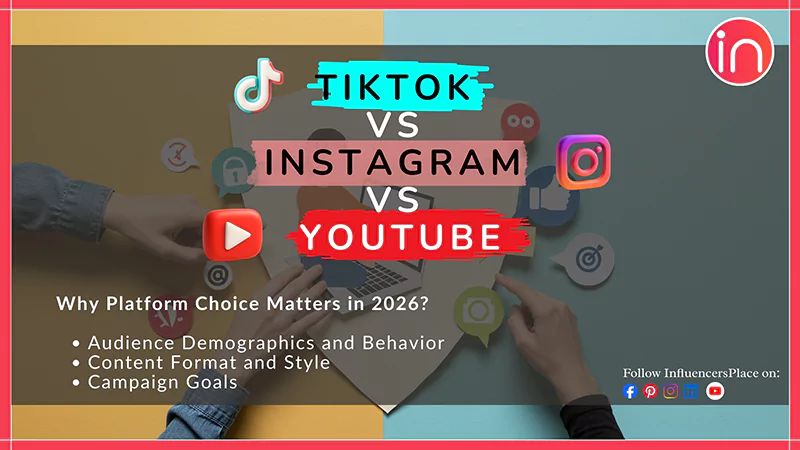
Platform choice matters because each one serves a different audience, prioritizes different content styles and formats, and offers unique monetization and discoverability opportunities.
The reasons below contribute to determining why platform choice matters in 2026:
- Audience Demographics and Behavior: Different platforms have different user bases. This helps in determining the platform that pertains to the brand’s target audience.
User Bases TikTok Instagram YouTube Gen Z and younger millennials. Young adults (Gen Z, millennials) Everyone (all ages, genders, locations)
- Content Format and Style: It is the natural ability of a platform to dominate the type of content that performs well. Here’s a detailed overview.
Type of Content TikTok Instagram YouTube Short-form, creative, and trend-based videos Highly visual, ideal for fashion, beauty, and lifestyle content Long-form content, tutorials, and in-depth product reviews
- Campaign Goals: You should refer to a platform that aligns with your marketing objectives.
- For Brand Awareness and Broad Reach: Refer to platforms like Instagram, TikTok, and YouTube.
- For Driving Direct Sales and Conversions: Refer to platforms like Instagram and TikTok.
- For Building Trust and Niche Engagement: Refer to platforms like Instagram.
Platform Overview: TikTok, Instagram, and YouTube Explained
TikTok, Instagram, and YouTube are video-centric platforms, but they differ in focus. TikTok excels at short, viral, trend-driven content for broad discovery.
Instagram blends short Reels with photos/carousels for visual storytelling and community. YouTube dominates long-form video (tutorials, gaming, deep dives) but also offers Shorts, acting as a massive search engine for video content.
Here’s a detailed overview of these three platforms:
TikTok:
TikTok is an extensively popular short video sharing platform. It generally thrives on trend-driven video (15s to 3min or more long); its undertone is usually authentic, raw, humorous, and personality-focused.
Here’s a complete overview of TikTok:
Origin: Launched as Douyin in China in 2016 by ByteDance.
Essential Features:
- Short videos (3s-60m) on diverse topics.
- Highly personalized “For You” (FYP) feed.
- In-app editing, extensive music library, filters, and effects.
- Relies heavily on trending sounds and music, often sparking trends.
User Base and Engagement:
- Billions of downloads and monthly users globally.
- High daily usage, with users spending significant time scrolling.
Instagram:

It focuses on a mix of short (Reels) & long-form (Feed), targeting a broad audience, from young adults to older demographics; it connotes aesthetic, lifestyle, aspirational, and community-focused content.
Here’s a complete overview of Instagram:
Origin: Originated in San Francisco in 2010 as Burbn. Later renamed as Instagram, combining “instant camera” and “telegram“.
Essential Features:
- Permanent photo/video uploads.
- Ephemeral (24-hour) photo/video snippets with interactive stickers.
- Short, fun, entertaining videos with music, effects, and editing tools.
- Real-time broadcasts for direct audience engagement.
User Base and Engagement:
- Launched in October 2010, with immediate success, getting 25,000 users on day one.
- Currently, Instagram has over 2 billion monthly active users.
- 50% of users interact with brands daily, making it essential for marketing.
YouTube:

YouTube primarily focuses on long-form videos, emphasizing a massive and diverse audience. It implies informative, educational, entertaining, and evergreen content.
Here’s a complete overview of YouTube:
Origin: Originated in 2005 from three former PayPal employees: Chad Hurley, Steve Chen, and Jawed Karim.
Essential Features:
- Hosts vast amounts of video, supports uploads, streaming, and file sharing.
- Easily share videos across social media platforms.
- Uses AI for features like video transcripts, search, and personalized suggestions.
User Base and Engagement:
- Over 2.5 billion monthly active users, reaching across 100+ countries and 80 languages.
- Users average about 48.7 minutes daily on the platform.
Let’s explore the features of these platforms in detail.
Comparing Features: TikTok, Instagram & YouTube

As a brand, it is an absolutely inevitable step to extensively research the platforms and the services, and the reach they can provide to your brand. Therefore, here’s a detailed differentiation focusing on TikTok vs Instagram vs YouTube.
Refer to the table below:
| Platforms | Best For | Features | Audience |
TikTok |
|
|
|
Instagram |
|
|
|
YouTube |
|
|
|
With their ever-expanding features, these social media platforms have proved to be one of the most significant parts of brand endorsements. Apart from these features, there are certain other pros and cons that a brand has to keep in mind before opting to invest in social media.
Read ahead to find out the pros and cons.
Pros and Cons of Investing In Social Media as a Brand

Investing in social media as a brand is crucial for modern growth, offering cost-effective reach, direct audience engagement, and brand building. However, there are many drawbacks to consider additionally.
Here’s a list of pros and cons that may turn out to be a must for you to go through before opting for investing in social media (TikTok, YouTube, and Instagram):
Pros and Cons of Investing In TikTok
TikTok is ideal if you target younger audiences and are prepared to invest in consistent, creative, authentic video content. However, it’s less suitable for brands targeting comparatively older demographics.
Here’s a table of the pros and cons that a brand should keep in mind before opting for TikTok as an endorsement platform:
Pros and Cons of Investing In YouTube

Investing in YouTube is powerful for brands that can commit to high-quality videos that are also consistent, value deep audience engagement, and see video as a long-term marketing strategy. However, it also consists of some detriments.
Refer to the table below for both pros and cons of choosing YouTube to endorse your brand:
Pros and Cons of Investing In Instagram

Instagram is an impactful tool for brand endorsements. Its unique engagement and sales potential can get you committed to consistent content. However, some drawbacks still prevail.
Refer to the table for an extensive explanation of the same:
A brand must skim through these pros and cons before pooling in the resources.
Wrapping Up!
Wrapping it up, TikTok vs Instagram vs YouTube, brands should approach the respective social media platform according to their needs and the demographic niche they want to target.
Brands seeking a niche-based audience must opt for Instagram, taking into account its focus on visual storytelling through photos and short videos, and converting the audience into an ideal customer profile.
In contrast, pick TikTok considering its powerful algorithm for viral reach, authentic short-form video format, and rich User-Generated Content.
Whereas, choose YouTube bearing in mind its long video format, evergreen SEO, and stronger customer loyalty. However, a brand must substantially utilize all three of them to augment its reach to a broader level of audience.
Authors Note
In this blog, I have listed all possibilities, significant features, and pros and cons of TikTok vs YouTube vs Instagram as social media platforms, used by brands to promote themselves. If you want to expand your brand among Gen Z, consider Instagram; if you want to expand internationally, opt for TikTok; consider YouTube for general, non-niche-specific brand growth.
If you are a brand and are looking for a way to reach out to influencers, consider hiring an agency like InfluencersPlace. With their low cost, no hidden charges, creators’ first approach, and transparent reporting, they can transform the outlook of your brand. However, if you are looking for a human and AI amalgamation, in your approach, you can also consider Socialveins, Famekeeda, or Chtrbox.
Frequently Asked Questions
What is the social media marketing trend in 2026?
Which is more profitable, YouTube, Instagram, or TikTok?
YouTube offers the highest-paying platform-driven income, whereas TikTok and Instagram rely more on creator-driven income.
Where should brands invest in 2026?
In 2026, brands should invest in authentic, long-term partnerships with influencer marketing, keeping in mind the platforms TikTok, YouTube, and Instagram.
Why platform choice matters in 2026?
Platform choice matters significantly in 2026 because every platform has its own virtues, different demographic divisions, different target age groups, and different visibility prospects.
Is it better to start YouTube, Instagram, or TikTok marketing?
It is better to use all three of them strategically, using YouTube for long-format videos, TikTok for shorts, and Instagram for behind-the-scenes.
Related Posts