Ans: No, you will not lose control over your content if you negotiate usage rights before signing the contract.
How Digital Ads and Programmatic Ecosystems Are Transforming Today’s Influencer Market
 Written By Shilpi Samantray
 Reviewed By: Nitin Rathore
“Data is the new oil, but it’s only valuable if you know how to refine it into a strategy.”
If you think that being an influencer is just about getting pretty pictures and putting a link in your bio, you are only seeing the surface.
Behind the scenes, the way brands work with creators has evolved significantly. It has moved from slow to manual emails to a high-speed and automated market where data is the most important thing that you own.
Today, every creator, whether you have 500 followers or 5 million, is a part of the huge digital ad network. Your content is not just a post anymore; it is a valuable piece of real estate that brands bid on in real-time auctions.
This article will guide you on how these machines are changing the game and why learning how they work is your new secret weapon to success.
Key Takeaways
- Programmatic ad is the primary way to sell digital ads.
- Detailed audience insights are more valuable than high follower counts.
- Influencer content is being treated as a high-performance ad unit in the broader marketing circle.
- Use AI tools to understand your audience better.
Understanding Programmatic Advertising in the Influencer Economy
In the early days, a brand deal included back-and-forth emails, manual contracts, and prayers that the audience would see the post. Now, programmatic advertising has entered the chat. Simply put, programmatic advertising is the automated buying and selling of online advertising space.
Instead of a human negotiating the price, software handles the transaction in milliseconds. For you as an influencer, this means that your worth is being calculated by algorithms before a brand even touches your media kit.
When you host ads on your blog or allow brands to run ‘dark posts’ using your handle, you are interacting with the SmartlyAds programmatic ad platform and similar tech platforms. These platforms ensure that the right users come across the right content at the exact moment they are most likely to convert.
Evolving from the ‘what’ to the ‘how’ is essential to look at the gears shifting behind the scenes to make these instant interactions possible.
How Automated Ad Buying Works
Automated ad buying uses Real-Time Bidding (RTB) to auction off ad space. Think of it like a high-speed eBay for eyeballs. When a user clicks on your content, a request is sent to an ad exchange. Advertisers then bid on that impression based on how well that user fits their target profile.
As a creator, understand that this helps you realize that you are not just selling posts, you are actually selling access. Automated systems allow brands to scale their influencer efforts without the need to hire many managers.
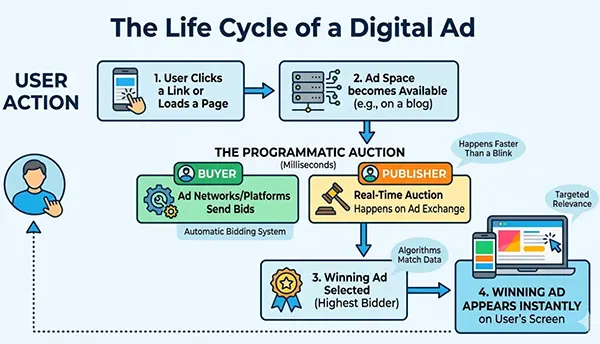
This flowchart will help you understand how your post becomes a live auction piece in milliseconds. It is a simple look at how data and tech select the perfect ad for your audience immediately.
The Role of Data and Audience Targeting
The current trend shows that businesses need to study consumer behavior instead of chasing their entire customer base. The system uses special data to identify all viewers who can watch your content. It enables the ‘machine’ to find your ideal audience at the best time.
- First-Party Data: It is the information that you collect directly from the users, such as emails.
- Third-Party Data: This is the data obtained from observing and tracking behavioral patterns across the web.
- Contextual Data: It ensures that a fitness ad appears on a fitness creator’s video.
How Digital Advertising Platforms Are Integrating Influencer Campaigns
Nowadays, influencer marketing and big-budget ad teams are basically becoming the same. Brands are using something called ‘Allow listing’ which is nothing but a fancy way of saying that they can get your permission to run ads directly through your social media account.
This allows them to use smart tech to push your posts through thousands of users who don’t even follow you yet. Because your content is added to these ad systems, it lives much longer.
Instead of your post dying after 24 hours like a normal story or grid post, it stays active for months. It comes a high-performing ad that keeps on circulating among users and finds new fans for you while you are asleep.
This combination makes your hard work last way longer. Instead of your post disappearing into an old feed after a day, it stays alive as a constant discovery tool, which keeps your content popping up for new fans for a long time.
Did You Know?
It takes just 10 to 30 milliseconds for a programmatic auction to complete.
The Role of AI and Data Analytics in Influencer Ad Campaigns
Instead of just being a giant calculator, these smart systems work in the background to connect your creative posts with what people actually want to buy. Here is how they bridge the gap for you:
- Dynamic Creative Optimization: The system can automatically swap out headlines or background colors in your ads to see which version makes your followers stop scrolling.
- Micro-Moment Targeting: AI technology determines the optimal moment when users click on content by displaying coffee advertisements during the early morning hours when users begin their online activities.
- Predictive Trend Analysis: AI spots patterns across millions of accounts, and it can tell the brands which vibe or aesthetic is about to go viral before it even happens.
- Audience Sentiment Mapping: AI technology analyzes your comment section to decide whether people believe your promoted brand after it counts your total number of likes.
- Fraud Detection Shields: Advanced algorithms act as a digital bodyguard that instantly filters out ‘click farms’ and fake accounts to ensure that only real humans come across your sponsored content.
Challenges Brands and Influencers Face in Programmatic Advertising
Running automated ads can get really messy. Since computers handle everything in the background, you might not always know which brands are using your name, or when they will stop running the ads. This means you may end up promoting products you don’t even like, which makes you look completely fake to your fans.
On top of that, new privacy rules indicate that you have to be very careful with the personal information of your followers. You almost have to act like a security guard to make sure their data stays safe.
Finally, if you just let the ads run themselves on autopilot, they may end up annoying your audience. The system could show your fans the exact same ad over and over again, and spamming them like that is a fast way to make people hit the unfollow button.
Best Practices for Brands Using Programmatic Influencer Campaigns
The automated era needs brands to follow some basic guidelines for their operations:
- High-quality content should become the main focus for a brand because even top algorithms fail to rescue uninteresting videos.
- Influencers need to disclose their usage rights because their likenesses appear in programmatic advertisements.
- Brands can select a hybrid approach that uses programmatic advertising for the audience reach but maintains human involvement during the creative process.
- Use real-time data to monitor analytics and know if a campaign is hitting its benchmarks.
| Strategy Component | What is the Purpose? |
| A/B Testing | It helps in finding which creative hook works best. |
| Whitelisting | It extends the brand’s reach beyond organic followers. |
| Retargeting | It keeps the brand top-of-mind for interested users. |
Final Thoughts
AI isn’t here to take your job; it’s here to help you move up to a bigger role. Instead of just being someone who makes posts, you are becoming the owner of your own media business.
You are not just creating content anymore; you are managing a valuable community that brands are excited to pay for. It is like moving from being a performer on a stage to owning the entire theater. This shift means you are building a real and long-lasting business.
Fun Fact: The first-ever banner ad has a click-through rate of 44%.
As the industry evolves, your biggest strength will be combining your raw human emotions with these high-tech tools. You are the architect who dreams up the experience, and the machine is just the fast, efficient builder that helps you put it all together. While everything else is becoming automated, your unique voice is one that a computer can’t copy.
Frequently Asked Questions
Ques: Will I lose control over my content because of programmatic advertising?
Ques: Can programmatic advertising help small influencers?
Ans: Yes! It often looks for niche engagement instead of mass reach, making it suitable for small influencers.
Ques: How to start with programmatic ads?
Ans: You can begin by personalizing your data. You also need to offer brands clear knowledge of who your audience is.
Ques: Is programmatic advertising expensive for creators to begin with?
Ans: No, most of the creators access it for free through networks that can simply take a percentage of the revenue generated.
Related Posts